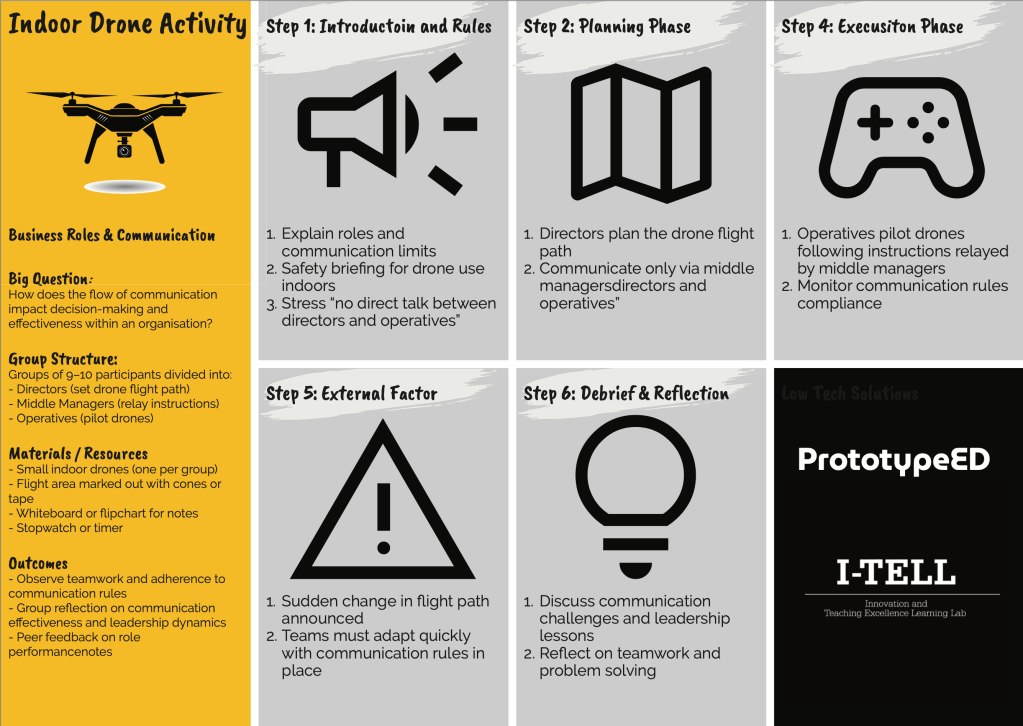
We talk a lot about teamwork and communication in business education, but rarely do we give students a meaningful way to feel the complexity of these dynamics. This post introduces a new PrototypeED resource designed to do just that – using drones.
🛰️ Why Drones? Why Now?
This one-pager offers a low-tech, high-impact lesson using small indoor drones to simulate organisational communication structures. It invites students to explore how information flows (or doesn’t) through hierarchy – and what that means for decision-making and leadership.
The activity works well in business, leadership or operations modules and is easy to run with minimal kit: a few drones, some cones or tape, and clear roles.
🛠️ What’s in the One-Pager?
At the heart of the resource is a Big Question:
How does the flow of communication impact decision-making and effectiveness within an organisation?
Students are split into teams of 9–10 and take on one of three roles:
- Directors – design the flight path
- Middle Managers – act as the only channel of communication
- Operatives – fly the drones, relying entirely on instructions passed down
Each group follows a six-step sequence:
- Introduction and Roles – setting the scene and boundaries
- Planning Phase – directors plan the path and cascade instructions
- Execution – operatives fly drones under communication constraints
- External Factor – a sudden change forces teams to adapt
- Debrief – groups reflect on what worked, what broke down
- Reflection – links to leadership theory and organisational behaviour
🧠 Why It Matters
This activity makes communication barriers tangible. Students experience the frustrations of unclear chains of command and the power of strong middle leadership. It naturally surfaces key themes: trust, delegation, adaptability, and feedback loops.
And crucially – it’s fun. It energises the room, reduces screen dependency, and builds shared experience that sticks.
📄 Download the One-Pager
 Creative Futures Innovation Toolkit
Leave a comment