• Our first I-TELL Show and Tell webinar set a strong foundation for the series, bringing colleagues together to explore practical approaches that strengthen learning, creativity, and student belonging.

    Tony Morgan from Leeds University opened the session with an engaging overview of diverge and converge techniques. His focus was how structured creative processes can support more equitable classroom experiences, giving every student a clear route to contribute, build confidence, and shape ideas with purpose.

    Clare McTurk from Manchester Fashion Institute shared the work she is leading on Education for Sustainable Development and the Sustainable Development Goals. Her examples demonstrated how sustainability can be woven into studio and academic practices in a way that inspires purpose, impact, and a strong sense of belonging for students preparing to enter the creative industries.

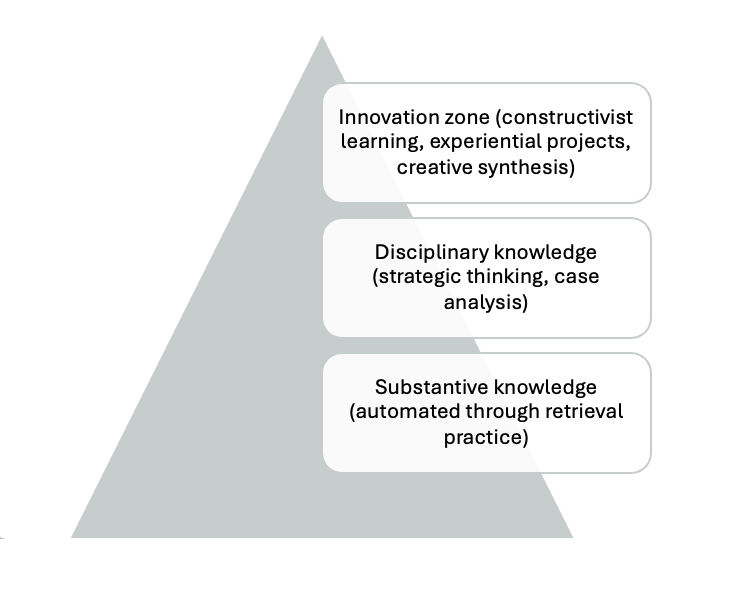
    I closed the session by outlining how I use Retrieval Practice to help learners secure foundational and disciplinary knowledge. The aim is to create the cognitive space for richer experiential work, where students can apply their knowledge, explore ideas, and build creative confidence.

  • This post builds on work by Willingham, Karpicke and Blunt, Bjork, Wheelahan, Chi and colleagues, and the practical guidance of Sherrington, Jones and Hendrick.

    Business Schools talk a lot about creativity, innovation and experiential learning. Yet none of these thrive unless students can recall core concepts and frameworks with ease. Retrieval practice offers a practical way to strengthen this foundation. When used well, it creates the conditions for deeper disciplinary thinking and gives students the cognitive space to innovate.

    This post summarises the approach I shared at the recent I-TELL Show and Tell session, focusing on how retrieval practice can be redesigned for Business Education.

    The innovation paradox

    Educators often face a familiar question. How can we support creativity and active learning without slipping into surface-level tasks or overloading students?

    The answer lies in recognising a simple principle. Students cannot innovate if they cannot remember what they need to think with. Substantive knowledge such as theories, frameworks and models must be secure. Disciplinary knowledge, including how to analyse cases or critique strategies, depends on this first layer.

    Research from cognitive science makes it clear that working memory is limited. When students struggle to recall basic ideas, they cannot engage in complex reasoning. Effective retrieval practice solves this problem by strengthening long-term memory and freeing up capacity for higher order tasks.

    Students remember what they think about

    Daniel Willingham’s phrase captures it neatly. Students remember what they think about. Retrieval practice ensures that what they think about is the knowledge we want them to retain.

    Three points matter here:

    1. Attention flows into working memory.
    2. Working memory is limited.
    3. Retrieval strengthens long-term memory far more effectively than rereading or passive review.
    Willingham’s Simple Memory Model Created by Oliver Caviglioli Nick Rose, Harry Fletcher-Wood and colleagues from the Institute for Teaching in winter 2019.

    When students practise bringing knowledge to mind, the neural pathways strengthen. This makes disciplinary thinking possible.

    Retrieval practice reimagined for Business Education

    Much of the literature presents retrieval practice as a tool for improving exam performance. In Business Schools, the assessment landscape is shifting. We use fewer traditional exams and more applied, authentic tasks such as case discussions, live briefs, simulations and business projects.

    For these approaches to work, students need immediate access to foundational knowledge. A team tackling a live brief cannot pause to look up SWOT, Porter’s Five Forces or pricing strategy models. Retrieval practice embedded in teaching solves that problem by making the basics automatic.

    Three simple strategies you can use tomorrow

    These approaches work in large lectures, seminars or executive workshops. Each one is low effort but high impact.

    1. Free recall at the start of a session

    Ask students to write down everything they know about a key concept without using notes. After a short individual attempt, they compare answers in pairs and then participate in a brief class discussion. This uncovers misconceptions, signals forgotten content and prepares the room for deeper learning.

    2. Self-explanation

    Before starting a case discussion, ask students to explain to themselves why a strategy succeeded or failed. This builds the bridge between substantive knowledge and disciplinary reasoning. By the time the case discussion begins, students have activated the tools they need.

    3. Paired retrieval

    One student quizzes the other using a knowledge organiser or framework sheet. They switch roles after a few minutes. The room becomes a space of simultaneous retrieval and feedback. It brings Dylan Wiliam’s principle of activating learners as instructional resources to life.

    Retrieval Practice in the Age of AI

    Students increasingly outsource thinking to generative AI tools. This creates a new challenge for Business Schools. When AI completes the cognitive work, students miss the essential processes that strengthen memory, build disciplinary fluency, and develop creative confidence. Studies warn that over-reliance on automated outputs reduces cognitive engagement, weakens long-term retention, and can limit students’ ability to think divergently. Retrieval practice becomes more important in this context because it protects the core intellectual work of recalling, connecting and applying ideas. It also helps students distinguish between AI as augmentation and AI as automation. Designing sessions that foreground independent retrieval gives students a stronger foundation for using AI critically and responsibly.

    Guiding principles for effective implementation

    To make retrieval practice work across a programme, six principles help.

    1. Spread practice across time rather than concentrating it in one session.
    2. Introduce challenge early.
    3. Keep activities low stakes and focused on learning.
    4. Make the strategy explicit, so students understand why it helps them.
    5. Connect retrieval tasks to authentic disciplinary goals.
    6. Avoid relying on heroic levels of preparation. Routine is the aim.

    Does knowledge-rich teaching reduce creativity?

    This concern is common in Business Schools. Yet the evidence points in the other direction. Creativity depends on the ability to combine ideas in novel ways. Retrieval practice strengthens the knowledge students need for this. When students no longer struggle to remember the basics, they have more capacity to generate new solutions.

    In short, knowledge and creativity complement each other. They are not rivals.

    Why retrieval practice fails in practice

    Carl Hendrick and others highlight common pitfalls.

    • Routine enforcement without understanding principles
    • Using retrieval only to prepare for tests
    • Making tasks too easy
    • Disconnecting activities from disciplinary application
    • Not explaining the cognitive science

    Addressing these points increases the likelihood of success and improves student engagement.

    A starting point for colleagues

    If you want to build retrieval practice into your teaching, begin with one strategy. Use it consistently. Explain the rationale to students. Link the activity to the disciplinary thinking you want them to use.

    Small, sustainable steps make the most difference.


    The ideas outlined here draw on established research in cognitive science and curriculum theory, including work by Willingham, Bjork, Karpicke and Blunt, Chi, Wheelahan, Sherrington, Jones and Hendrick.

    Further reading

    • Kate Jones, Retrieval Practice
    • Tom Sherrington, Knowledge-Rich Curriculum
    • Jamie Clark, Seven Essential Principles
    • Karpicke and Blunt (2011)
    • Willingham (2009)
    • Wheelahan (2010)

  • I am pleased to share the recording of my recent presentation, delivered as part of the Open University’s Cross University Scholarship Seminar Series: Enhancing Student Success, which took place from 30 June to 7 July 2025.

    The series brought together colleagues from the Open University, Manchester Metropolitan, Cardiff, and Lancaster Universities to explore innovative approaches to promoting student achievement across legal and business education.

    In my presentation, titled Reclaiming Creativity in Business Education: Lessons from Secondary School Teaching, I examined how approaches such as retrieval practice, explicit instruction, formative assessment, and dual coding can be adapted to higher education. I then turned to the question of creativity. If business schools are serious about producing graduates who can lead change, creativity cannot be treated as an optional enrichment activity.

    You can watch the presentation here: https://stadium.open.ac.uk/stadia/preview.php?whichevent=3985&s=31


  • When I worked as a secondary school teacher, creativity wasn’t an add-on. It was the job. Lessons invited curiosity, risk-taking, and connection across subjects. There was structure, yes, but within it, space to play with ideas. That belief has never left me.


    In higher education, I often hear creativity spoken about as something for the arts, or something that happens only after the “real work” is done. But what if we took it seriously from the start?


    In this short piece for Advance HE, I reflect on the creative roots of my teaching practice and ask what HE might learn from school classrooms. It’s part of a wider question I keep coming back to:

    This works in school. How might we do something similar in HE?

    You can read the blog post here:

  • As graduation week approaches, I’ve been reflecting on the journey this past year. My second year as a university lecturer has felt like a turning point. It has been a time of development, both professionally and personally, and I feel more confident about the direction I want to take.

    In my first year, I was focused on settling into the role, learning the systems, and getting to grips with the realities of teaching in higher education. Although I had worked in the sector before, stepping into a full academic role brought a new set of responsibilities and expectations. It was a steep but rewarding learning curve. This year has been more about self-discovery, refining my interests, and taking on challenges that align with my values and strengths.

    One of the biggest milestones was taking on module leadership for Employability Skills and Managing your Digital Footprint, a unit with over 400 students. I was fortunate to be supported by John Byrne, whose guidance made a real difference. I was pleased with how it all came together, particularly the introduction of a video element to the assessment, which helped bring a more reflective and personal dimension to the students’ submissions.

    Working with our Chartered Management Degree Apprenticeship students continues to be one of the most rewarding aspects of my role. I’ve loved collaborating with Vicky on our modules and seeing the apprentices grow in confidence throughout their first year. Their ability to apply learning directly to the workplace makes the teaching feel relevant and impactful.

    Supervising final-year students on their Synoptic Business Projects has been another real privilege. I was genuinely inspired by the quality of their ideas and their commitment to exploring meaningful topics.

    I’ve also enjoyed working with David Evans on the Corporate Responsibility and Sustainability Apprenticeship. The first cohort delivered some excellent and thought-provoking work. Cohort two have brought great energy and fresh perspectives, which has made the teaching really enjoyable.

    This year I have also taken on the role of DELTA Lead within the department. A particular highlight has been working with Becky to explore how Adobe Express can support creative approaches to teaching. It has been exciting to look at how digital tools can help us communicate ideas more clearly and make learning experiences more engaging.

    Being part of the I-Tell committee has been equally rewarding. It is a fantastic group to be involved with, and it has been great to see how our shared resources are helping to make teaching more active and collaborative across the faculty.

    On a personal level, this year marked the beginning of my doctoral journey. I started with plenty of imposter syndrome and moments of self-doubt, but I am now starting to find my voice and enjoy the process. I am really grateful to Paul and Richard for their encouragement and support.

    Finally, I was proud to be promoted to Senior Lecturer. It feels like a meaningful step and a reflection of the progress I’ve made, as well as the fantastic colleagues and collaborators I’ve had the chance to work with. When I shared the news publicly, I was particularly touched by the kind messages from students, including a few I had taught back in my secondary school days. That meant a great deal.

    It has been a full and fulfilling year. I am looking forward to the next chapter.

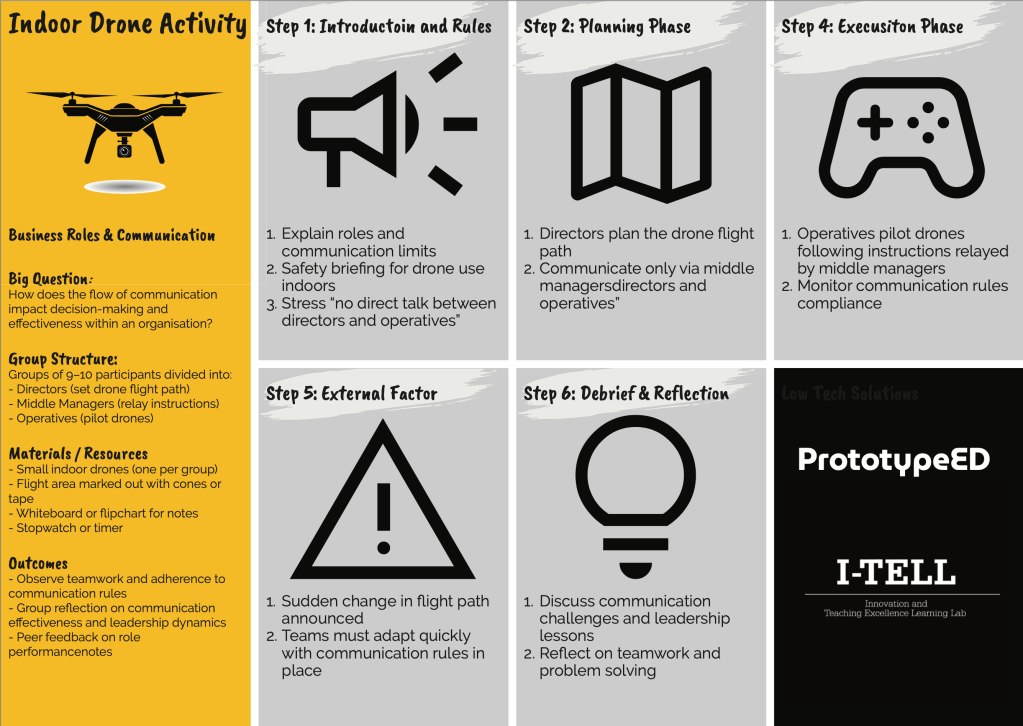
  • We talk a lot about teamwork and communication in business education, but rarely do we give students a meaningful way to feel the complexity of these dynamics. This post introduces a new PrototypeED resource designed to do just that – using drones.

    🛰️ Why Drones? Why Now?

    This one-pager offers a low-tech, high-impact lesson using small indoor drones to simulate organisational communication structures. It invites students to explore how information flows (or doesn’t) through hierarchy – and what that means for decision-making and leadership.

    The activity works well in business, leadership or operations modules and is easy to run with minimal kit: a few drones, some cones or tape, and clear roles.

    🛠️ What’s in the One-Pager?

    At the heart of the resource is a Big Question:
    How does the flow of communication impact decision-making and effectiveness within an organisation?

    Students are split into teams of 9–10 and take on one of three roles:

    • Directors – design the flight path
    • Middle Managers – act as the only channel of communication
    • Operatives – fly the drones, relying entirely on instructions passed down

    Each group follows a six-step sequence:

    1. Introduction and Roles – setting the scene and boundaries
    2. Planning Phase – directors plan the path and cascade instructions
    3. Execution – operatives fly drones under communication constraints
    4. External Factor – a sudden change forces teams to adapt
    5. Debrief – groups reflect on what worked, what broke down
    6. Reflection – links to leadership theory and organisational behaviour

    🧠 Why It Matters

    This activity makes communication barriers tangible. Students experience the frustrations of unclear chains of command and the power of strong middle leadership. It naturally surfaces key themes: trust, delegation, adaptability, and feedback loops.

    And crucially – it’s fun. It energises the room, reduces screen dependency, and builds shared experience that sticks.

    📄 Download the One-Pager

  • I really enjoyed presenting at The Square 2025, our recent I-TELL conference. This was a particularly meaningful moment for me. It was the first time I had shared independent scholarly research, and I wasn’t quite sure what to expect. There was an extra layer of emotional attachment to the work I was presenting.

    My session focused on the journey students take into higher education. Many arrive from systems dominated by terminal exams and surface-level learning. At the same time, employers tell us they want graduates who are creative, adaptable and able to think critically. We are caught in the middle of that tension, and my research is an attempt to make sense of it.

    As part of my DEE project, I explored how assessment policy influences what we can do in the classroom. The literature made it clear that rigid policy often restricts innovation. It limits the space we have to design assessments that nurture creativity and allow students to take risks.

    In my talk, I offered a few recommendations for colleagues. One was to try out alternative assessment formats and see how they land with students. Another was to think about a wider cultural shift in assessment, moving away from ideas of punishment and towards trust, dialogue and meaningful learning.

    Thank you to Professor Paul Ashwin – Lancaster University – for the feedback and support.

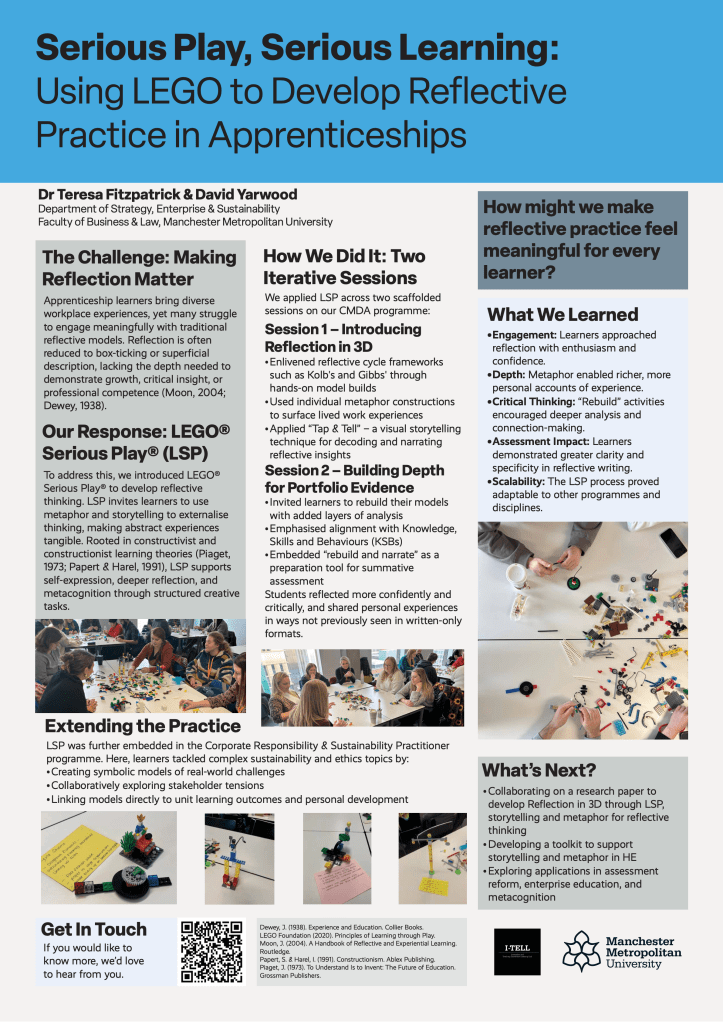
  • Too often, reflective practice in higher education is treated as a checkbox exercise, particularly in apprenticeships where learners juggle complex workplace experiences and academic expectations. Traditional written reflections can struggle to capture the nuance of learning that unfolds on the job.

    At Manchester Met, we’ve been exploring how LEGO® Serious Play® (LSP) can reframe reflection as a creative, embodied, and meaningful process. Using LSP, our learners externalise their thinking, build metaphors of real experiences, and narrate stories that make visible their development against professional competencies.

    Over two scaffolded sessions, students:

    • Used models to bring Kolb’s and Gibbs’ reflective cycles to life,
    • Rebuilt and annotated reflections to deepen analysis, and
    • Connected experiences to the apprenticeship KSBs.

    The results? Richer reflections, greater confidence, and evidence of deeper critical thinking. One learner described it best: “This is the first time I’ve really understood how to reflect—without just writing what happened.”

    We’re now extending the work across other programmes, including sustainability and ethics education, and developing a Reflection in 3D toolkit to support wider adoption.

    If you’re interested in helping learners move beyond ‘tick-box’ reflection, get in touch. Let’s build something better—literally.

  • I recently attended a brilliant I-Tell session led by Emily Atkinson, Subject Leader of Social Sciences at a secondary school in Warwickshire. Emily offered a fascinating window into the assessment experiences of students before they arrive in Higher Education.

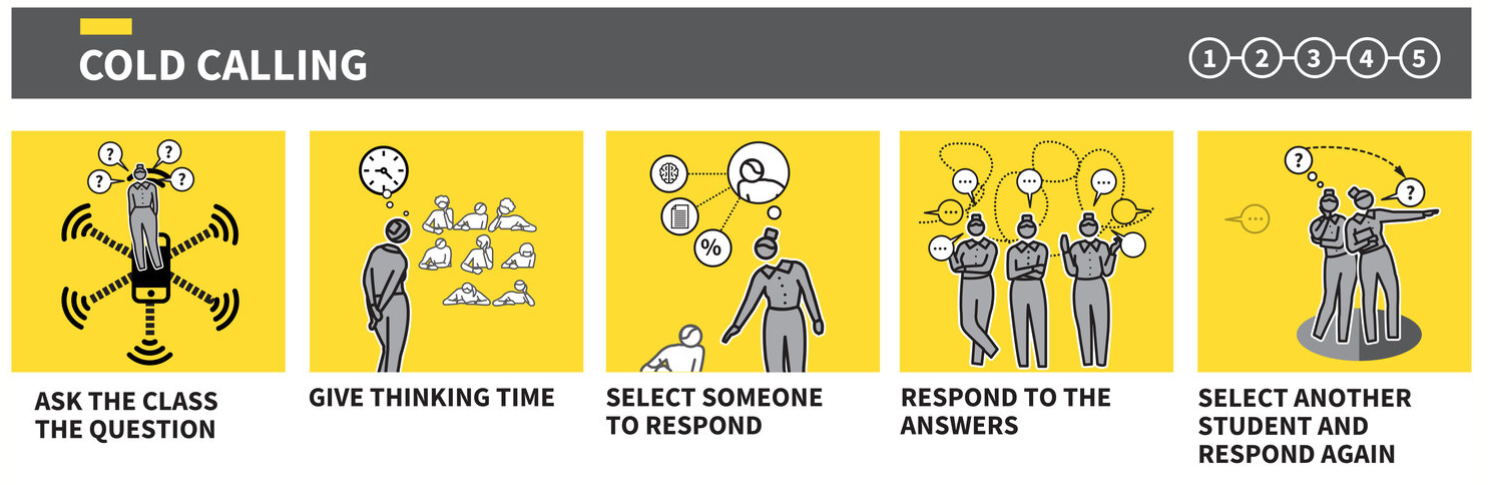
    One such practice was cold calling, a teaching approach I used routinely and championed in my secondary days. I still do it now, although probably less frequently in HE. There seems to be a reluctance to put students on the spot. However, when done thoughtfully, cold calling isn’t about catching people out. It is about including everyone. It creates shared accountability for learning and ensures all voices are valued, not just the confident few who always volunteer.

    It was refreshing to hear insights from someone with a background similar to mine. Before moving into HE, I spent nearly 20 years in secondary schools, taking on roles such as Head of Department and Head of Year. Much of what Emily described felt very familiar and yet it raised some good questions about how our classroom practices evolve (or get left behind) when we change sectors.

    From Teacherhead blog https://teacherhead.com/2021/02/07/cold-calling-the-1-strategy-for-inclusive-classrooms-remote-and-in-person/

    Tom Sherrington’s blog post Cold Calling: The #1 Strategy for Inclusive Classrooms – Remote and In-Person offers a clear and practical explanation of the approach. He argues that cold calling is not about pressure or performance. It is about building a culture where every student is expected to think and contribute. This is proactive inclusion. Rather than waiting for volunteers, it brings everyone into the learning conversation. Sherrington highlights how cold calling:

    • Provides thinking time before asking for responses, so it feels fair
    • Encourages students to be mentally prepared, knowing they might be called on
    • Builds a sense of community where everyone is expected to engage
    • Normalises participation and reduces anxiety by making it routine

    It is a subtle shift. Instead of asking who knows the answer?, we say let’s hear from you next. That small change can have a big impact on classroom dynamics.

    So, to my HE colleagues: Do you cold call?
    And to our students: Was this something you experienced in school? How did it feel?

    I’d love to know what you think.

  • By David Yarwood

    I have long believed that we talk too much about innovation in education and do too little to design for it. This post introduces the first in a series of one-page resources I am developing to help shift that balance.

    These one-pagers are part of a wider project that explores how assessment policy and institutional language can unintentionally limit the kind of rich, creative and responsive teaching that students need. Rather than waiting for policy change, this project focuses on building tools that enable action now, supporting educators to design meaningful learning experiences within existing structures.

    This first resource focuses on the Design Sprint. Originally developed by Google Ventures and influenced by IDEO’s design thinking model, Design Sprints are fast, focused processes that help students tackle real-world problems. Learners move from understanding a challenge to testing a prototype in a short, structured sequence. The method promotes collaboration, experimentation and risk-taking in a way that is easy to embed into HE teaching.


    💡 What’s in the One-Pager?

    The resource breaks the sprint process into five clear steps:

    1. Understand and Empathise
    2. Define and Frame
    3. Ideate and Create
    4. Prototype and Refine
    5. Test and Pitch

    Each step includes a short explanation, a practical classroom technique (such as Crazy 8s or Empathy Mapping), and a facilitation tip to help colleagues lead the activity effectively. The resource can be used in workshops, seminars or assessment settings, and works particularly well in enterprise, employability or sustainability contexts.

    The guide also highlights the EntreComp competencies students develop through the sprint, including creativity, teamwork, planning, and initiative. Depending on the topic, the activity can also support key Sustainable Development Goals (SDGs). For example, our recent Wellbeing Sprint mapped clearly to:

    • SDG 3 – Good Health and Wellbeing
    • SDG 8 – Decent Work and Economic Growth

    🛠️ Why It Matters

    Assessment in higher education can sometimes prioritise outputs over learning. A Design Sprint, by contrast, values process. It creates space for students to take creative risks, reflect, and build ideas iteratively. This kind of learning supports both academic development and real-world readiness.

    Whether your focus is innovation, enterprise, or student engagement, the sprint method encourages learners to move from passive participation to active problem solving. It helps them see their learning as something that matters beyond the classroom.


    📄 Download the One-Pager

    👉 Download the Design Sprint Guide (PDF)


    Let’s teach different.
    If you would like to share how you are using this resource, or collaborate on additional one-pagers, feel free to get in touch. I would love to hear from you.