When I worked as a secondary school teacher, creativity wasn’t an add-on. It was the job. Lessons invited curiosity, risk-taking, and connection across subjects. There was structure, yes, but within it, space to play with ideas. That belief has never left me.
In higher education, I often hear creativity spoken about as something for the arts, or something that happens only after the “real work” is done. But what if we took it seriously from the start?
In this short piece for Advance HE, I reflect on the creative roots of my teaching practice and ask what HE might learn from school classrooms. It’s part of a wider question I keep coming back to:
This works in school. How might we do something similar in HE?
As graduation week approaches, I’ve been reflecting on the journey this past year. My second year as a university lecturer has felt like a turning point. It has been a time of development, both professionally and personally, and I feel more confident about the direction I want to take.
In my first year, I was focused on settling into the role, learning the systems, and getting to grips with the realities of teaching in higher education. Although I had worked in the sector before, stepping into a full academic role brought a new set of responsibilities and expectations. It was a steep but rewarding learning curve. This year has been more about self-discovery, refining my interests, and taking on challenges that align with my values and strengths.
One of the biggest milestones was taking on module leadership for Employability Skills and Managing your Digital Footprint, a unit with over 400 students. I was fortunate to be supported by John Byrne, whose guidance made a real difference. I was pleased with how it all came together, particularly the introduction of a video element to the assessment, which helped bring a more reflective and personal dimension to the students’ submissions.
Working with our Chartered Management Degree Apprenticeship students continues to be one of the most rewarding aspects of my role. I’ve loved collaborating with Vicky on our modules and seeing the apprentices grow in confidence throughout their first year. Their ability to apply learning directly to the workplace makes the teaching feel relevant and impactful.
Supervising final-year students on their Synoptic Business Projects has been another real privilege. I was genuinely inspired by the quality of their ideas and their commitment to exploring meaningful topics.
I’ve also enjoyed working with David Evans on the Corporate Responsibility and Sustainability Apprenticeship. The first cohort delivered some excellent and thought-provoking work. Cohort two have brought great energy and fresh perspectives, which has made the teaching really enjoyable.
This year I have also taken on the role of DELTA Lead within the department. A particular highlight has been working with Becky to explore how Adobe Express can support creative approaches to teaching. It has been exciting to look at how digital tools can help us communicate ideas more clearly and make learning experiences more engaging.
Being part of the I-Tell committee has been equally rewarding. It is a fantastic group to be involved with, and it has been great to see how our shared resources are helping to make teaching more active and collaborative across the faculty.
On a personal level, this year marked the beginning of my doctoral journey. I started with plenty of imposter syndrome and moments of self-doubt, but I am now starting to find my voice and enjoy the process. I am really grateful to Paul and Richard for their encouragement and support.
Finally, I was proud to be promoted to Senior Lecturer. It feels like a meaningful step and a reflection of the progress I’ve made, as well as the fantastic colleagues and collaborators I’ve had the chance to work with. When I shared the news publicly, I was particularly touched by the kind messages from students, including a few I had taught back in my secondary school days. That meant a great deal.
It has been a full and fulfilling year. I am looking forward to the next chapter.
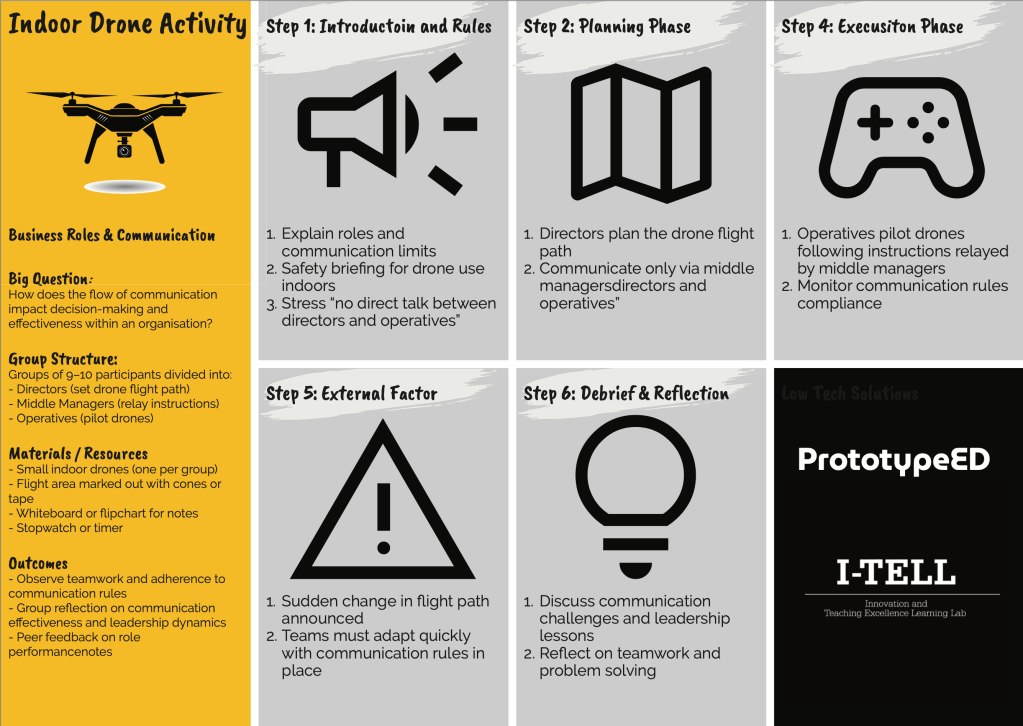
We talk a lot about teamwork and communication in business education, but rarely do we give students a meaningful way to feel the complexity of these dynamics. This post introduces a new PrototypeED resource designed to do just that – using drones.
🛰️ Why Drones? Why Now?
This one-pager offers a low-tech, high-impact lesson using small indoor drones to simulate organisational communication structures. It invites students to explore how information flows (or doesn’t) through hierarchy – and what that means for decision-making and leadership.
The activity works well in business, leadership or operations modules and is easy to run with minimal kit: a few drones, some cones or tape, and clear roles.
🛠️ What’s in the One-Pager?
At the heart of the resource is a Big Question: How does the flow of communication impact decision-making and effectiveness within an organisation?
Students are split into teams of 9–10 and take on one of three roles:
Directors – design the flight path
Middle Managers – act as the only channel of communication
Operatives – fly the drones, relying entirely on instructions passed down
Each group follows a six-step sequence:
Introduction and Roles – setting the scene and boundaries
Planning Phase – directors plan the path and cascade instructions
Execution – operatives fly drones under communication constraints
External Factor – a sudden change forces teams to adapt
Debrief – groups reflect on what worked, what broke down
Reflection – links to leadership theory and organisational behaviour
🧠 Why It Matters
This activity makes communication barriers tangible. Students experience the frustrations of unclear chains of command and the power of strong middle leadership. It naturally surfaces key themes: trust, delegation, adaptability, and feedback loops.
And crucially – it’s fun. It energises the room, reduces screen dependency, and builds shared experience that sticks.
I really enjoyed presenting at The Square 2025, our recent I-TELL conference. This was a particularly meaningful moment for me. It was the first time I had shared independent scholarly research, and I wasn’t quite sure what to expect. There was an extra layer of emotional attachment to the work I was presenting.
My session focused on the journey students take into higher education. Many arrive from systems dominated by terminal exams and surface-level learning. At the same time, employers tell us they want graduates who are creative, adaptable and able to think critically. We are caught in the middle of that tension, and my research is an attempt to make sense of it.
As part of my DEE project, I explored how assessment policy influences what we can do in the classroom. The literature made it clear that rigid policy often restricts innovation. It limits the space we have to design assessments that nurture creativity and allow students to take risks.
In my talk, I offered a few recommendations for colleagues. One was to try out alternative assessment formats and see how they land with students. Another was to think about a wider cultural shift in assessment, moving away from ideas of punishment and towards trust, dialogue and meaningful learning.
Thank you to Professor Paul Ashwin – Lancaster University – for the feedback and support.
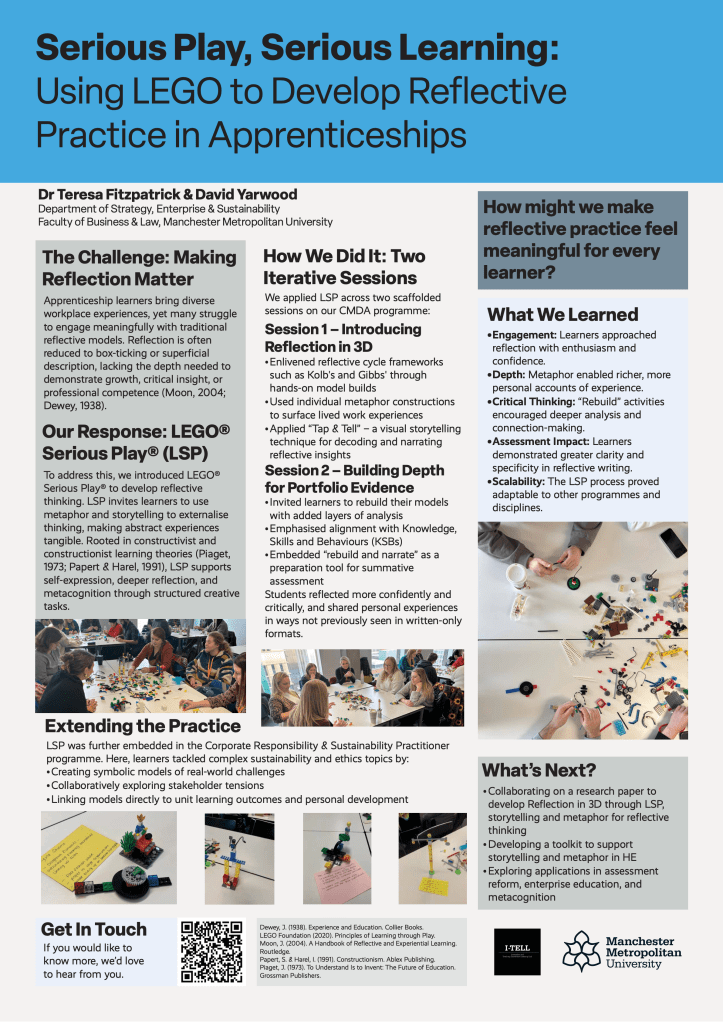
Too often, reflective practice in higher education is treated as a checkbox exercise, particularly in apprenticeships where learners juggle complex workplace experiences and academic expectations. Traditional written reflections can struggle to capture the nuance of learning that unfolds on the job.
At Manchester Met, we’ve been exploring how LEGO® Serious Play® (LSP) can reframe reflection as a creative, embodied, and meaningful process. Using LSP, our learners externalise their thinking, build metaphors of real experiences, and narrate stories that make visible their development against professional competencies.
Over two scaffolded sessions, students:
Used models to bring Kolb’s and Gibbs’ reflective cycles to life,
Rebuilt and annotated reflections to deepen analysis, and
Connected experiences to the apprenticeship KSBs.
The results? Richer reflections, greater confidence, and evidence of deeper critical thinking. One learner described it best: “This is the first time I’ve really understood how to reflect—without just writing what happened.”
We’re now extending the work across other programmes, including sustainability and ethics education, and developing a Reflection in 3D toolkit to support wider adoption.
If you’re interested in helping learners move beyond ‘tick-box’ reflection, get in touch. Let’s build something better—literally.
I recently attended a brilliant I-Tell session led by Emily Atkinson, Subject Leader of Social Sciences at a secondary school in Warwickshire. Emily offered a fascinating window into the assessment experiences of students before they arrive in Higher Education.
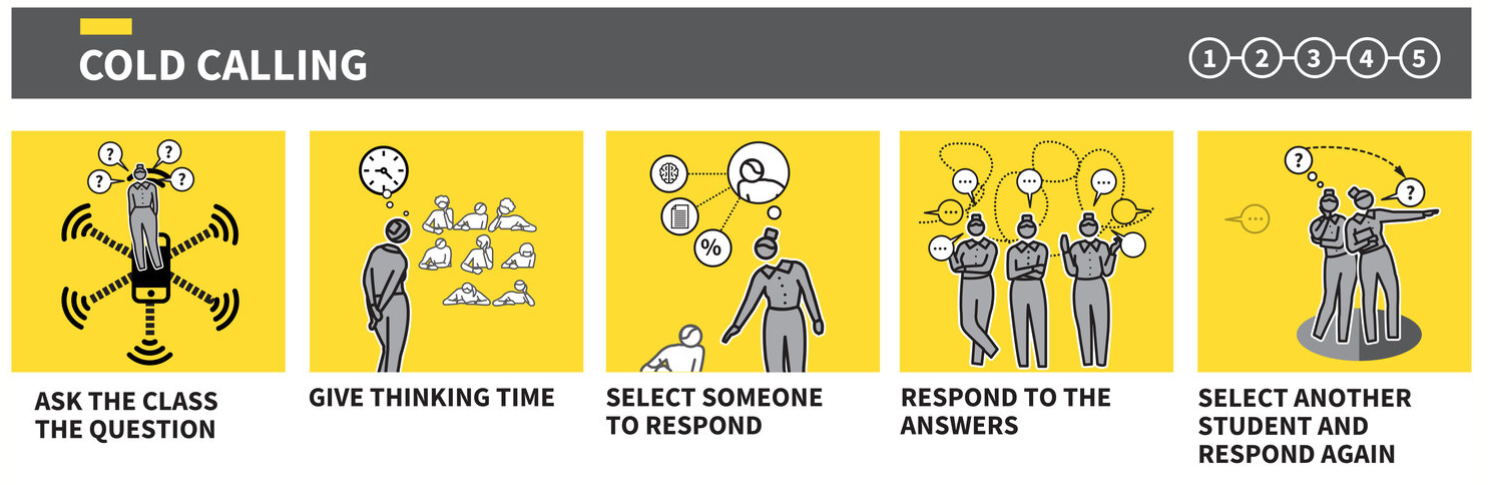
One such practice was cold calling, a teaching approach I used routinely and championed in my secondary days. I still do it now, although probably less frequently in HE. There seems to be a reluctance to put students on the spot. However, when done thoughtfully, cold calling isn’t about catching people out. It is about including everyone. It creates shared accountability for learning and ensures all voices are valued, not just the confident few who always volunteer.
It was refreshing to hear insights from someone with a background similar to mine. Before moving into HE, I spent nearly 20 years in secondary schools, taking on roles such as Head of Department and Head of Year. Much of what Emily described felt very familiar and yet it raised some good questions about how our classroom practices evolve (or get left behind) when we change sectors.
Tom Sherrington’s blog post Cold Calling: The #1 Strategy for Inclusive Classrooms – Remote and In-Person offers a clear and practical explanation of the approach. He argues that cold calling is not about pressure or performance. It is about building a culture where every student is expected to think and contribute. This is proactive inclusion. Rather than waiting for volunteers, it brings everyone into the learning conversation. Sherrington highlights how cold calling:
Provides thinking time before asking for responses, so it feels fair
Encourages students to be mentally prepared, knowing they might be called on
Builds a sense of community where everyone is expected to engage
Normalises participation and reduces anxiety by making it routine
It is a subtle shift. Instead of asking who knows the answer?, we say let’s hear from you next. That small change can have a big impact on classroom dynamics.
So, to my HE colleagues: Do you cold call? And to our students: Was this something you experienced in school? How did it feel?
I have long believed that we talk too much about innovation in education and do too little to design for it. This post introduces the first in a series of one-page resources I am developing to help shift that balance.
These one-pagers are part of a wider project that explores how assessment policy and institutional language can unintentionally limit the kind of rich, creative and responsive teaching that students need. Rather than waiting for policy change, this project focuses on building tools that enable action now, supporting educators to design meaningful learning experiences within existing structures.
This first resource focuses on the Design Sprint. Originally developed by Google Ventures and influenced by IDEO’s design thinking model, Design Sprints are fast, focused processes that help students tackle real-world problems. Learners move from understanding a challenge to testing a prototype in a short, structured sequence. The method promotes collaboration, experimentation and risk-taking in a way that is easy to embed into HE teaching.
💡 What’s in the One-Pager?
The resource breaks the sprint process into five clear steps:
Understand and Empathise
Define and Frame
Ideate and Create
Prototype and Refine
Test and Pitch
Each step includes a short explanation, a practical classroom technique (such as Crazy 8s or Empathy Mapping), and a facilitation tip to help colleagues lead the activity effectively. The resource can be used in workshops, seminars or assessment settings, and works particularly well in enterprise, employability or sustainability contexts.
The guide also highlights the EntreComp competencies students develop through the sprint, including creativity, teamwork, planning, and initiative. Depending on the topic, the activity can also support key Sustainable Development Goals (SDGs). For example, our recent Wellbeing Sprint mapped clearly to:
SDG 3 – Good Health and Wellbeing
SDG 8 – Decent Work and Economic Growth
🛠️ Why It Matters
Assessment in higher education can sometimes prioritise outputs over learning. A Design Sprint, by contrast, values process. It creates space for students to take creative risks, reflect, and build ideas iteratively. This kind of learning supports both academic development and real-world readiness.
Whether your focus is innovation, enterprise, or student engagement, the sprint method encourages learners to move from passive participation to active problem solving. It helps them see their learning as something that matters beyond the classroom.
Let’s teach different. If you would like to share how you are using this resource, or collaborate on additional one-pagers, feel free to get in touch. I would love to hear from you.
When we talk about innovation in higher education, assessment is often the elephant in the seminar room. Despite bold claims about graduate attributes and creativity, much of our assessment practice remains rooted in risk-averse, standardised, and compliance-driven models.
Over the past year, I’ve been exploring this tension more deeply — most recently through a Critical Discourse Analysis of UK university assessment policies, which I’ve submitted for academic review. The early insights weren’t surprising, but they were sobering:
Assessment policies often reinforce institutional priorities such as efficiency, surveillance, and standardisation — rather than enabling creativity, flexibility, or pedagogical responsiveness.
Even the rise of AI, which could transform feedback and personalisation, is frequently framed as a threat to be policed, rather than a tool to be used creatively.
So what do we do about it?
That’s the driving question behind this project: a Teaching & Learning Toolkit for Innovation and Creativity: a set of practical, adaptable, and research-informed approaches that put risk-taking, reflection, and real-world problem-solving back into the heart of the student experience.
🌱 What’s in the Toolkit?
Each post in this new series will explore a specific theme, idea or classroom strategy that can help us move towards more authentic and empowering learning. Early topics include:
💡 Design Sprints: Applying rapid prototyping methods from the creative industries into classroom-based problem solving.
🔄 Ungrading: Shifting the focus from marks to meaningful feedback and self-reflection.
🧠 Metacognition: Helping students understand and direct their own learning processes.
🧭 Assessing the Process: Designing assessments that reward iteration, collaboration, and intellectual curiosity — not just polished outputs.
🛠️ Why a Toolkit?
I’m not suggesting we abandon standards or rigour, far from it. But if our goal is to prepare students to think critically, act entrepreneurially, and adapt in uncertain futures, we need assessment practices that reflect those values.
This toolkit is about building capacity, for students and staff, to teach, learn and assess in ways that reflect the messiness of real-world challenges. It’s also a space for experimentation, informed by theory but grounded in day-to-day practice.
🧭 What’s Next?
In my next post, I’ll share a simple framework for using Design Sprints in a classroom setting — including a downloadable guide you can adapt for your own context.
If any of this resonates, I’d love to hear from you. What’s getting in the way of creative assessment in your own practice? What would you like to see in the toolkit?
This research project aims to enhance entrepreneurial competencies among students within the Faculty of Business and Law through the development and implementation of an ‘Innovation and Creativity in Teaching and Learning Toolkit.’ The toolkit will comprise a range of guides for activities, lessons, and teaching case studies that support the development of key enterprise and entrepreneurial skills. The methodology includes a mixed-method approach involving a review of existing practices, the establishment of a Community of Practice, and the creation of a comprehensive toolkit. The project will be piloted within a Level 5 unit to assess its effectiveness in enhancing student competencies, using pre- and post-intervention surveys.
The expected outcomes include the identification of best practices, the development of innovative teaching resources, and the establishment of a sustainable Community of Practice focused on creativity and innovation in education. The anticipated impact includes improved student readiness for the workforce, enhanced teaching practices across the faculty, and sparking a more innovative and creative mindset among both students and staff. This project aligns with the faculty’s strategic aims and supports the development of an inclusive and future-focused curriculum that equips students with the tools to thrive in rapidly changing markets.
I thoroughly enjoyed listening to this podcast. Through our Degree Apprenticeship projects we are looking at ways to encourage out learners to become ‘impact intrapreneurs’.