Our students built personal Adobe Express web pages instead of writing the usual reflective assignment. The interesting part was to see how much personalisation and ownership students took over the finished product once the brief stopped asking for a document and started asking for something they would actually want an employer to see. I have since presented the model at the Learning Enhancement and Educational Development Conference, and it has picked up interest well beyond my own department.
Levelling Up Industry Pitches with a Professional Platform (with Dr Vicky Nowak)
Vicky Nowak and I replaced a written report with a ten-minute video pitch for 40 Chartered Manager Degree Apprentices, all already working across a range of companies. Before anything was built, half the students had never done a video assessment, half were worried about speaking on camera, half were not sure they would be marked fairly against something so different from an essay. This insight infomed the support we built in to the module.
Both case studies, and the detail on what we changed, why, and what we would do differently next time, are in Adobe’s full Showcase: Driving Success in Business Schools – Integrating Multimodal Learning in Curriculum.
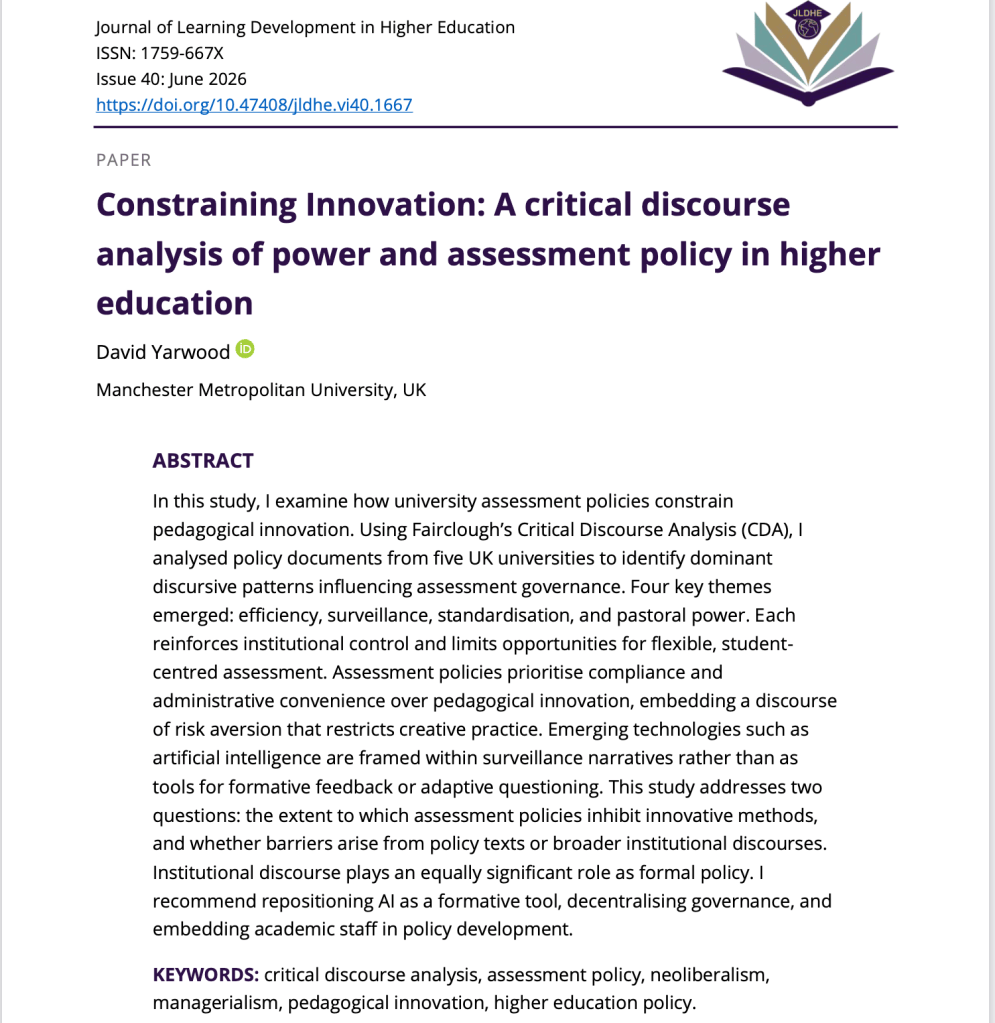
I’m pleased to share that my article, “Constraining Innovation: A Critical Discourse Analysis of Power and Assessment Policy in Higher Education,” is now published in the Journal of Learning Development in Higher Education.
The paper started life as an assignment on the doctoral programme at Lancaster University and became something I kept returning to, because the argument felt unfinished. At its centre is a question that matters practically as well as theoretically: when assessment policies claim to protect standards, what else are they doing? Using Fairclough’s Critical Discourse Analysis across policy documents from five UK universities, the paper traces how discourses of efficiency, surveillance, standardisation, and pastoral power collectively construct an institutional environment that is structurally resistant to pedagogical innovation.
The revision process pushed the argument further than I expected, particularly around AI. Not as a technology to evaluate, but as a discursive object being shaped, permitted, and frustrated by the policy environments we have already built.
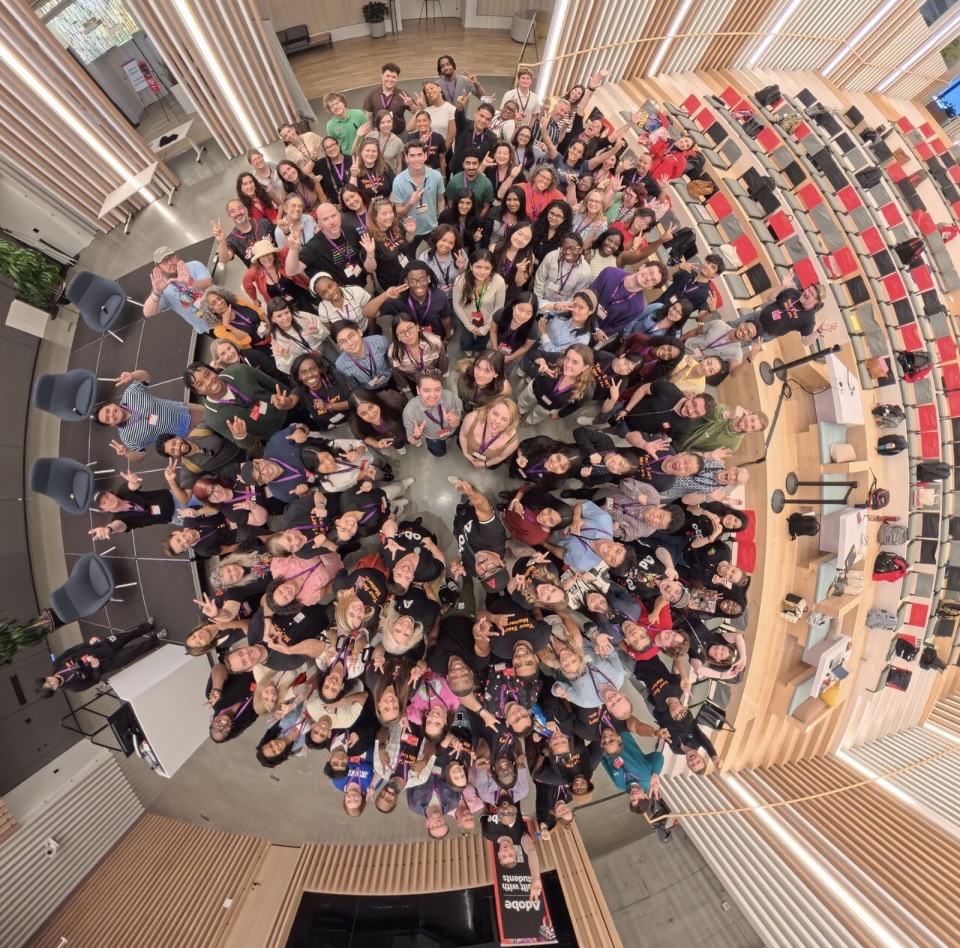
I am pleased to have been selected for the inaugural Adobe Higher Education Faculty Leader Cohort, one of a global group spanning 33 countries for 2026–27. Part of the year included a visit to Adobe’s headquarters in San Jose, where it was wonderful to meet students and educators from across the globe, as well as have some rich discussions with Adobe colleagues on all things digital tech and AI. Closer to home, the more interesting question is what a Faculty of Business and Law can do inside a cohort most people would assume belongs to design departments and creative arts schools.
Manchester Met is already an Adobe Creative Campus. It is easy to assume that status sits with the art and design side of the institution and stops there. It does not have to. Visual communication, digital storytelling, and the ability to build a coherent argument in something other than a Word document are business skills now, not decorative extras. Our students will pitch, present, and persuade using tools that did not exist when most business curricula were last redesigned.
The cohort runs for a year, and San Jose set the tone for what is to come. I am looking forward to seeing what comes of it, for the business school as much as for me.
Has knowledge been forgotten? Notes from Cambridge
I had a wonderful couple of days at Jesus College, Cambridge, for the 8th Cambridge Symposium on Knowledge in Education. I was very pleased to have the opportunity to share my research with colleagues who have inspired my work. Thank you to Leesa Wheelahan and Johan Muller, who were so generous with their time and kind words. It is a strange thing to present an argument built on someone’s ideas while they sit in the room. Strange, and useful.
I presented my ongoing PhD work around the idea that knowledge has been forgotten in business education. The short version. I analysed five years of abstracts from two leading management education journals, using Legitimation Code Theory as the lens. On the surface the field looks knowledge-rich. The scholarship is theoretically ambitious and methodologically strong. But very little of it treats disciplinary knowledge, what business students actually need to know, as a substantive concern. Knowledge has not been lost. It has been crowded out by other priorities, and I think the consequences matter most for the students with the least to fall back on.
Since the conference I can see how Bernstein’s islands might help to explain my findings. The corpus reads like a set of separate specialised islands with no obvious way of travelling between them. I am still working that through. And I have some work to do in linking thinking the not yet thought to Amabile’s componential model of creativity, which is where the thesis goes next. If disciplinary knowledge is what makes new thought possible, then domain-relevant skills are not the dull bit of creativity. They are the precondition for it.
I presented this research at the Assessment in Higher Education Conference in Manchester last week. It’s an annual gathering of people who think seriously about assessment, which meant the questions were sharp and the disagreements were productive. I’ve written up the argument below, and attached the one-pager I took into the room.
I’ve spent the last year reading assessment documents. Not marking them. Reading them as arguments.
Briefs, rubrics, programme handbooks, apprenticeship standards. The kind of paperwork that sits in institutional folders and gets updated once a year if someone remembers. Most people treat these as administrative. I wanted to know whether they add up as a theory of learning.
The method was Theory of Change, a framework usually applied to programmes and interventions to test whether the logic holds: do the inputs connect plausibly to the activities, do the activities lead to the outcomes, do the assumptions underneath actually bear weight? I pointed it at the documents themselves instead. Treat a brief like a small claim: do this task, structured this way, and it produces this learning. Then ask whether the claim is coherent.
Most of the ones I looked at weren’t incoherent exactly. They just didn’t follow through.
Here’s what I mean. Take creativity. Every programme I’ve looked at names it. Standards invoke it, rationales celebrate it, learning outcomes promise it. And then the assignment brief arrives, with its prescribed structure, its percentage weightings per section, its referencing requirements, its word count penalty for going over by ten percent. The rubric rewards breadth of sources. Reflection gets five percent of the mark. Collaboration, where it appears at all, is assessed individually.
Creativity doesn’t get squeezed out. It gets left behind at the point where aspiration meets criteria.
The same pattern shows up with professional judgement, with iteration, with the kind of thinking that is actually hard to outsource to an AI. Named as outcomes. Absent from what gets marked.
That gap is where the logic chain breaks. Not at the input end, where standards and quality frameworks sit, but at the enactment end, in the briefs and rubrics that translate institutional intention into student experience. And that is a more specific and more useful diagnosis than saying assessment is too compliance-driven, which most people working in higher education would agree with before going back to writing their rubrics the same way as last year.
One challenge from the room stuck with me: how much of this is specific to apprenticeship programmes with their particular regulatory pressures, and how much shows up across professional education more broadly?
Good question. I’m going back in with a second case to find out.
This week I led a session for the Manchester Metropolitan University Digital Futures Community of Practice on the theme of digital skills. I wanted to share some of what came out of it, because the conversation was realy rich and I think it surfaces some things the sector needs to sit with.
I started with a provocation. Most of our students last had formal IT teaching in Year 9. Think about that. By the time they arrive at university, they’ve spent years immersed in technology, but almost none of it has been purposeful, professional, or deliberately developmental. They’re fluent on TikTok. They’re lost in a spreadsheet.
This isn’t a pipeline problem alone. I carried out a small practitioner inquiry with eighteen apprenticeship students before a video pitch assessment. Working professionals. Already in employment. Average confidence with digital tools: two out of five. One student wrote: “worried that having a video might make me stutter and get nervous and worry and cost me a grade.” These aren’t school leavers finding their feet. The gap persists into professional life because nobody ever addressed it directly.
The digital natives myth has been comprehensively dismantled by researchers. Kirschner and De Bruyckere argued that students may be equipped with technological skills but are not always digitally literate in using technology to support their learning. Prensky, who coined the term, eventually moved on from it himself. But a lot of institutional practice still hasn’t caught up.
What I’ve been trying to do in my own teaching is close the gap between exposure and capability through deliberate design. The portfolio module at levels four and five builds professional digital identity through RISE, IBM Skills Build, LinkedIn Learning, and the JISC discovery tool. Recruitment simulations ask students to deploy subject knowledge, digital capability, and professional judgement simultaneously. Adobe Express appears repeatedly across the programme because familiarity reduces cognitive load and leaves space for the actual thinking.
The bigger argument is about programme-level design. Biggs was right, students learn what they’re assessed on. If digital capability doesn’t appear in the learning outcomes, it stays invisible. It becomes something individual enthusiastic lecturers do until they leave or the module changes. Constructive alignment makes it structural rather than personal.
Then there’s AI. I didn’t want to spend too long here because this is the theme of the next session, but the connection to digital skills is too important to ignore. We used to cringe when students cited Wikipedia uncritically. Not because Wikipedia is useless, but because citing it without judgement showed that the student hadn’t developed the capacity to evaluate a source. AI is the same problem at a completely different scale.
My research, just accepted for publication in the Journal of Learning Development in Higher Education, found that where AI appeared in university assessment policies at all, it appeared in supplementary guidance rather than core frameworks, and was framed around misconduct detection rather than pedagogical possibility. Institutions are training students and staff to see AI as a threat to manage rather than a tool to interrogate. That’s the wrong frame.
The expert interrogates. The novice accepts. A student who has built disciplinary knowledge and critical thinking can sit down with an AI tool and do something genuinely useful with it. They can spot the hallucination. They can identify what’s missing. They can push back. A student without that grounding will use AI to fill the gap, and they won’t know the gap is there.
I used two examples in the session that seemed to land. The first was equity and diversity. Ask AI to write a job description and it will produce something that looks professional and complete. Ask a student who has studied structural inequality and understands what the Equality Act actually requires, and they’ll immediately see what the AI got wrong. The second was reflection. Students who have had genuinely formative experiences on placement or in simulation hand that experience to an AI and ask it to write their reflection for them. The AI produces something coherent and hollow. The student had the raw material for genuine insight. They just didn’t trust themselves to articulate it.
Digital skills matter enormously to our students. But digital tools should accelerate learning, not replace it. The messy moment when a student doesn’t know how to structure their argument, that’s not a problem to be solved by AI. That’s the moment learning happens.
The session used a How Might We approach from IDEO and the Stanford d.school, and the responses from the room were revealing. A few that stayed with me: “frame skill development around the things you do rather than the tool you use, so data analysis instead of Excel.” “Develop an autonomous digital mindset rather than a digital skills set.” “Teach principles, not tools, wherever possible.” “The only constant in future workplaces is change.”
Rod Cullen made a point that’s worth repeating. His old boss Jim Petch used to say we’ll know we’ve cracked a problem when we stop talking about it as much. We’re not there yet with digital skills. But sessions like this one suggest we’re at least asking better questions.
Our students arrive fluent. The job is to make them conceptualised, powerful, and transformed. Not just TikTok fluent.
Our second I-TELL Show and Tell webinar shifted the spotlight onto two complementary themes: making learning visible over time, and creating immersive spaces that extend what a business school experience can look and feel like for students and partners.
Vincent Pattison: using Miro as a long-format learning space
We welcomed Vincent Pattison (Manchester Fashion Institute), who shared a compelling, practice-led approach to Miro. Rather than treating Miro as a “one-off workshop board”, Vincent positions it as a long-format module space, almost like a shared studio wall or a digital sketchbook that grows week by week.
His live example, from a Level 4 cohort, illustrated a simple but powerful rhythm:
Start belonging early: students posted introductory “about me” panels before teaching began, so the first taught session already had a sense of identity, familiarity, and community.
Capture learning in real time: in-class activities (portraits, collage work, mood boards, fieldwork evidence, short videos) were uploaded during the session, creating a shared record by the end of the timetabled time.
Make progress visible: students could see what “good participation” looks like, compare their position against the ongoing work of peers in constructive ways, and re-enter the learning journey quickly if they missed a week.
Build confidence to share: putting work on a board reduces the pressure of “standing up and holding something”, enabling students to talk about artefacts with a tutor and peers, when they feel ready.
Vincent also connected this approach to DELTA’s principles, emphasising that tools should serve pedagogy, not the other way round. A key message that landed well across the room was the value of process over product, particularly as we think about how to reduce last-minute, low-authenticity outputs and instead reward sustained learning through the semester.
Dr Andrew Wilson: a live tour of the Manchester Met Metaverse
Our second headline contribution came from Dr Andrew Wilson, who gave a tour of the Manchester Met Metaverse and then invited attendees inside for a live demonstration. Built initially via an I-TELL Accelerator Fund application, Andrew explained how the project began as a schematic “digital twin” of the Business School’s ground floor and has since grown into a space with multiple potential uses.
Andrew outlined four emerging user cases:
International recruitment: offering prospective students a way to explore the Business School remotely, with embedded content and course information.
Immersive teaching: functioning lecture theatres that can host live sessions with shared slides and in-world interaction.
Co-curricular activity: linking students to central support, simulations, and employability activity in a space that still feels connected to the curriculum.
Digital real estate: future potential for partners, conferences, and exhibitions to use the space.
The demonstration brought these ideas to life: interactive hotspots, embedded videos, links to simulations, course information “stands”, and lecture theatre screen-sharing. The discussion also surfaced sensible questions, including how this differs from earlier virtual worlds (including Second Life) and where value sits long-term. The most convincing argument was practical: wider access, more stable infrastructure, clearer institutional use-cases, and a stronger focus on belonging, recruitment, and scalable delivery.
What we are taking forward
Two threads stood out across both contributions:
Design for participation: create routes for every student to contribute early, safely, and regularly.
Build environments that support continuity: whether a Miro board or a metaverse space, the aim is sustained engagement and a shared learning story, not isolated activities.
If you are working on something you would like to share at a future Show and Tell, particularly something you are piloting, refining, or preparing for conference season, please get in touch.
Our first I-TELL Show and Tell webinar set a strong foundation for the series, bringing colleagues together to explore practical approaches that strengthen learning, creativity, and student belonging.
Tony Morgan from Leeds University opened the session with an engaging overview of diverge and converge techniques. His focus was how structured creative processes can support more equitable classroom experiences, giving every student a clear route to contribute, build confidence, and shape ideas with purpose.
Clare McTurk from Manchester Fashion Institute shared the work she is leading on Education for Sustainable Development and the Sustainable Development Goals. Her examples demonstrated how sustainability can be woven into studio and academic practices in a way that inspires purpose, impact, and a strong sense of belonging for students preparing to enter the creative industries.
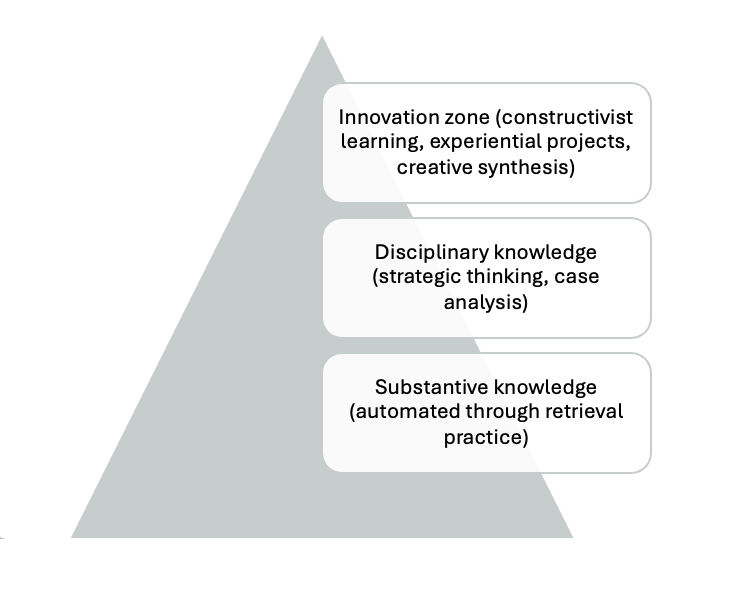
I closed the session by outlining how I use Retrieval Practice to help learners secure foundational and disciplinary knowledge. The aim is to create the cognitive space for richer experiential work, where students can apply their knowledge, explore ideas, and build creative confidence.
This post builds on work by Willingham, Karpicke and Blunt, Bjork, Wheelahan, Chi and colleagues, and the practical guidance of Sherrington, Jones and Hendrick.
Business Schools talk a lot about creativity, innovation and experiential learning. Yet none of these thrive unless students can recall core concepts and frameworks with ease. Retrieval practice offers a practical way to strengthen this foundation. When used well, it creates the conditions for deeper disciplinary thinking and gives students the cognitive space to innovate.
This post summarises the approach I shared at the recent I-TELL Show and Tell session, focusing on how retrieval practice can be redesigned for Business Education.
The innovation paradox
Educators often face a familiar question. How can we support creativity and active learning without slipping into surface-level tasks or overloading students?
The answer lies in recognising a simple principle. Students cannot innovate if they cannot remember what they need to think with. Substantive knowledge such as theories, frameworks and models must be secure. Disciplinary knowledge, including how to analyse cases or critique strategies, depends on this first layer.
Research from cognitive science makes it clear that working memory is limited. When students struggle to recall basic ideas, they cannot engage in complex reasoning. Effective retrieval practice solves this problem by strengthening long-term memory and freeing up capacity for higher order tasks.
Students remember what they think about
Daniel Willingham’s phrase captures it neatly. Students remember what they think about. Retrieval practice ensures that what they think about is the knowledge we want them to retain.
Three points matter here:
Attention flows into working memory.
Working memory is limited.
Retrieval strengthens long-term memory far more effectively than rereading or passive review.
Willingham’s Simple Memory Model Created by Oliver Caviglioli Nick Rose, Harry Fletcher-Wood and colleagues from the Institute for Teaching in winter 2019.
When students practise bringing knowledge to mind, the neural pathways strengthen. This makes disciplinary thinking possible.
Retrieval practice reimagined for Business Education
Much of the literature presents retrieval practice as a tool for improving exam performance. In Business Schools, the assessment landscape is shifting. We use fewer traditional exams and more applied, authentic tasks such as case discussions, live briefs, simulations and business projects.
For these approaches to work, students need immediate access to foundational knowledge. A team tackling a live brief cannot pause to look up SWOT, Porter’s Five Forces or pricing strategy models. Retrieval practice embedded in teaching solves that problem by making the basics automatic.
Three simple strategies you can use tomorrow
These approaches work in large lectures, seminars or executive workshops. Each one is low effort but high impact.
1. Free recall at the start of a session
Ask students to write down everything they know about a key concept without using notes. After a short individual attempt, they compare answers in pairs and then participate in a brief class discussion. This uncovers misconceptions, signals forgotten content and prepares the room for deeper learning.
2. Self-explanation
Before starting a case discussion, ask students to explain to themselves why a strategy succeeded or failed. This builds the bridge between substantive knowledge and disciplinary reasoning. By the time the case discussion begins, students have activated the tools they need.
3. Paired retrieval
One student quizzes the other using a knowledge organiser or framework sheet. They switch roles after a few minutes. The room becomes a space of simultaneous retrieval and feedback. It brings Dylan Wiliam’s principle of activating learners as instructional resources to life.
Retrieval Practice in the Age of AI
Students increasingly outsource thinking to generative AI tools. This creates a new challenge for Business Schools. When AI completes the cognitive work, students miss the essential processes that strengthen memory, build disciplinary fluency, and develop creative confidence. Studies warn that over-reliance on automated outputs reduces cognitive engagement, weakens long-term retention, and can limit students’ ability to think divergently. Retrieval practice becomes more important in this context because it protects the core intellectual work of recalling, connecting and applying ideas. It also helps students distinguish between AI as augmentation and AI as automation. Designing sessions that foreground independent retrieval gives students a stronger foundation for using AI critically and responsibly.
Guiding principles for effective implementation
To make retrieval practice work across a programme, six principles help.
Spread practice across time rather than concentrating it in one session.
Introduce challenge early.
Keep activities low stakes and focused on learning.
Make the strategy explicit, so students understand why it helps them.
Connect retrieval tasks to authentic disciplinary goals.
Avoid relying on heroic levels of preparation. Routine is the aim.
Does knowledge-rich teaching reduce creativity?
This concern is common in Business Schools. Yet the evidence points in the other direction. Creativity depends on the ability to combine ideas in novel ways. Retrieval practice strengthens the knowledge students need for this. When students no longer struggle to remember the basics, they have more capacity to generate new solutions.
In short, knowledge and creativity complement each other. They are not rivals.
Why retrieval practice fails in practice
Carl Hendrick and others highlight common pitfalls.
• Routine enforcement without understanding principles • Using retrieval only to prepare for tests • Making tasks too easy • Disconnecting activities from disciplinary application • Not explaining the cognitive science
Addressing these points increases the likelihood of success and improves student engagement.
A starting point for colleagues
If you want to build retrieval practice into your teaching, begin with one strategy. Use it consistently. Explain the rationale to students. Link the activity to the disciplinary thinking you want them to use.
Small, sustainable steps make the most difference.
The ideas outlined here draw on established research in cognitive science and curriculum theory, including work by Willingham, Bjork, Karpicke and Blunt, Chi, Wheelahan, Sherrington, Jones and Hendrick.
Further reading
• Kate Jones, Retrieval Practice • Tom Sherrington, Knowledge-Rich Curriculum • Jamie Clark, Seven Essential Principles • Karpicke and Blunt (2011) • Willingham (2009) • Wheelahan (2010)
I am pleased to share the recording of my recent presentation, delivered as part of the Open University’s Cross University Scholarship Seminar Series: Enhancing Student Success, which took place from 30 June to 7 July 2025.
The series brought together colleagues from the Open University, Manchester Metropolitan, Cardiff, and Lancaster Universities to explore innovative approaches to promoting student achievement across legal and business education.
In my presentation, titled Reclaiming Creativity in Business Education: Lessons from Secondary School Teaching, I examined how approaches such as retrieval practice, explicit instruction, formative assessment, and dual coding can be adapted to higher education. I then turned to the question of creativity. If business schools are serious about producing graduates who can lead change, creativity cannot be treated as an optional enrichment activity.