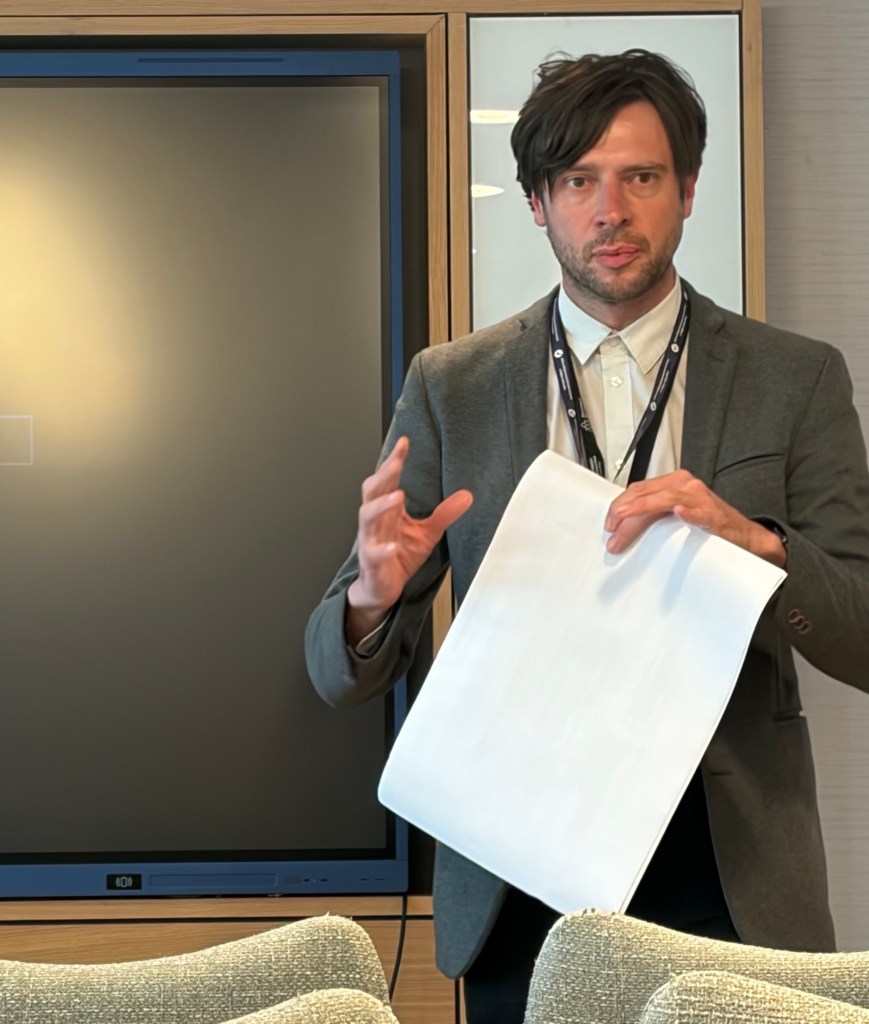
I presented this research at the Assessment in Higher Education Conference in Manchester last week. It’s an annual gathering of people who think seriously about assessment, which meant the questions were sharp and the disagreements were productive. I’ve written up the argument below, and attached the one-pager I took into the room.

I’ve spent the last year reading assessment documents. Not marking them. Reading them as arguments.
Briefs, rubrics, programme handbooks, apprenticeship standards. The kind of paperwork that sits in institutional folders and gets updated once a year if someone remembers. Most people treat these as administrative. I wanted to know whether they add up as a theory of learning.
The method was Theory of Change, a framework usually applied to programmes and interventions to test whether the logic holds: do the inputs connect plausibly to the activities, do the activities lead to the outcomes, do the assumptions underneath actually bear weight? I pointed it at the documents themselves instead. Treat a brief like a small claim: do this task, structured this way, and it produces this learning. Then ask whether the claim is coherent.
Most of the ones I looked at weren’t incoherent exactly. They just didn’t follow through.
Here’s what I mean. Take creativity. Every programme I’ve looked at names it. Standards invoke it, rationales celebrate it, learning outcomes promise it. And then the assignment brief arrives, with its prescribed structure, its percentage weightings per section, its referencing requirements, its word count penalty for going over by ten percent. The rubric rewards breadth of sources. Reflection gets five percent of the mark. Collaboration, where it appears at all, is assessed individually.
Creativity doesn’t get squeezed out. It gets left behind at the point where aspiration meets criteria.
The same pattern shows up with professional judgement, with iteration, with the kind of thinking that is actually hard to outsource to an AI. Named as outcomes. Absent from what gets marked.
That gap is where the logic chain breaks. Not at the input end, where standards and quality frameworks sit, but at the enactment end, in the briefs and rubrics that translate institutional intention into student experience. And that is a more specific and more useful diagnosis than saying assessment is too compliance-driven, which most people working in higher education would agree with before going back to writing their rubrics the same way as last year.
One challenge from the room stuck with me: how much of this is specific to apprenticeship programmes with their particular regulatory pressures, and how much shows up across professional education more broadly?
Good question. I’m going back in with a second case to find out.


Leave a Reply