• By David Yarwood

    I have long believed that we talk too much about innovation in education and do too little to design for it. This post introduces the first in a series of one-page resources I am developing to help shift that balance.

    These one-pagers are part of a wider project that explores how assessment policy and institutional language can unintentionally limit the kind of rich, creative and responsive teaching that students need. Rather than waiting for policy change, this project focuses on building tools that enable action now, supporting educators to design meaningful learning experiences within existing structures.

    This first resource focuses on the Design Sprint. Originally developed by Google Ventures and influenced by IDEO’s design thinking model, Design Sprints are fast, focused processes that help students tackle real-world problems. Learners move from understanding a challenge to testing a prototype in a short, structured sequence. The method promotes collaboration, experimentation and risk-taking in a way that is easy to embed into HE teaching.


    💡 What’s in the One-Pager?

    The resource breaks the sprint process into five clear steps:

    1. Understand and Empathise
    2. Define and Frame
    3. Ideate and Create
    4. Prototype and Refine
    5. Test and Pitch

    Each step includes a short explanation, a practical classroom technique (such as Crazy 8s or Empathy Mapping), and a facilitation tip to help colleagues lead the activity effectively. The resource can be used in workshops, seminars or assessment settings, and works particularly well in enterprise, employability or sustainability contexts.

    The guide also highlights the EntreComp competencies students develop through the sprint, including creativity, teamwork, planning, and initiative. Depending on the topic, the activity can also support key Sustainable Development Goals (SDGs). For example, our recent Wellbeing Sprint mapped clearly to:

    • SDG 3 – Good Health and Wellbeing
    • SDG 8 – Decent Work and Economic Growth

    🛠️ Why It Matters

    Assessment in higher education can sometimes prioritise outputs over learning. A Design Sprint, by contrast, values process. It creates space for students to take creative risks, reflect, and build ideas iteratively. This kind of learning supports both academic development and real-world readiness.

    Whether your focus is innovation, enterprise, or student engagement, the sprint method encourages learners to move from passive participation to active problem solving. It helps them see their learning as something that matters beyond the classroom.


    📄 Download the One-Pager

    👉 Download the Design Sprint Guide (PDF)


    Let’s teach different.
    If you would like to share how you are using this resource, or collaborate on additional one-pagers, feel free to get in touch. I would love to hear from you.

  • By David Yarwood

    When we talk about innovation in higher education, assessment is often the elephant in the seminar room. Despite bold claims about graduate attributes and creativity, much of our assessment practice remains rooted in risk-averse, standardised, and compliance-driven models.

    Over the past year, I’ve been exploring this tension more deeply — most recently through a Critical Discourse Analysis of UK university assessment policies, which I’ve submitted for academic review. The early insights weren’t surprising, but they were sobering:

    Assessment policies often reinforce institutional priorities such as efficiency, surveillance, and standardisation — rather than enabling creativity, flexibility, or pedagogical responsiveness.

    Even the rise of AI, which could transform feedback and personalisation, is frequently framed as a threat to be policed, rather than a tool to be used creatively.

    So what do we do about it?

    That’s the driving question behind this project: a Teaching & Learning Toolkit for Innovation and Creativity: a set of practical, adaptable, and research-informed approaches that put risk-taking, reflection, and real-world problem-solving back into the heart of the student experience.


    🌱 What’s in the Toolkit?

    Each post in this new series will explore a specific theme, idea or classroom strategy that can help us move towards more authentic and empowering learning. Early topics include:

    • 💡 Design Sprints: Applying rapid prototyping methods from the creative industries into classroom-based problem solving.
    • 🔄 Ungrading: Shifting the focus from marks to meaningful feedback and self-reflection.
    • 🧠 Metacognition: Helping students understand and direct their own learning processes.
    • 🧭 Assessing the Process: Designing assessments that reward iteration, collaboration, and intellectual curiosity — not just polished outputs.

    🛠️ Why a Toolkit?

    I’m not suggesting we abandon standards or rigour, far from it. But if our goal is to prepare students to think critically, act entrepreneurially, and adapt in uncertain futures, we need assessment practices that reflect those values.

    This toolkit is about building capacity, for students and staff, to teach, learn and assess in ways that reflect the messiness of real-world challenges. It’s also a space for experimentation, informed by theory but grounded in day-to-day practice.


    🧭 What’s Next?

    In my next post, I’ll share a simple framework for using Design Sprints in a classroom setting — including a downloadable guide you can adapt for your own context.

    If any of this resonates, I’d love to hear from you. What’s getting in the way of creative assessment in your own practice? What would you like to see in the toolkit?

  • This research project aims to enhance entrepreneurial competencies among students within the Faculty of Business and Law through the development and implementation of an ‘Innovation and Creativity in Teaching and Learning Toolkit.’ The toolkit will comprise a range of guides for activities, lessons, and teaching case studies that support the development of key enterprise and entrepreneurial skills. The methodology includes a mixed-method approach involving a review of existing practices, the establishment of a Community of Practice, and the creation of a comprehensive toolkit. The project will be piloted within a Level 5 unit to assess its effectiveness in enhancing student competencies, using pre- and post-intervention surveys.

    The expected outcomes include the identification of best practices, the development of innovative teaching resources, and the establishment of a sustainable Community of Practice focused on creativity and innovation in education. The anticipated impact includes improved student readiness for the workforce, enhanced teaching practices across the faculty, and sparking a more innovative and creative mindset among both students and staff. This project aligns with the faculty’s strategic aims and supports the development of an inclusive and future-focused curriculum that equips students with the tools to thrive in rapidly changing markets.

  • I thoroughly enjoyed listening to this podcast. Through our Degree Apprenticeship projects we are looking at ways to encourage out learners to become ‘impact intrapreneurs’.

  • I recently delivered a session on the University’s DELTA (Digitally Enhanced Learning, Teaching and Assessment) Strategy at our SES Department Away Day.

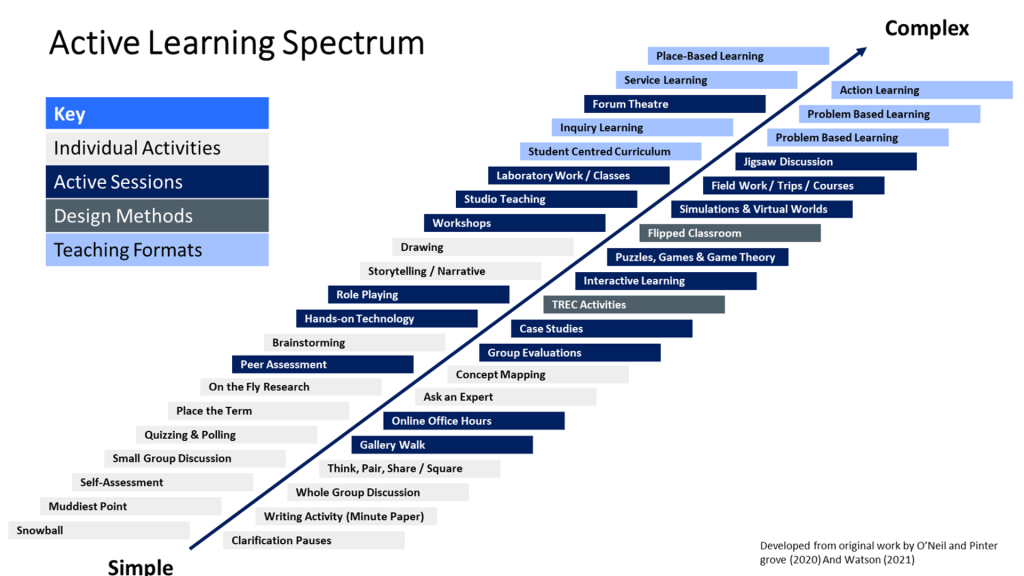
    We talked about where the Strategy fits in with the Road to 2030 and Education Strategies, with the main focus on our current approach to Flexible Active Learning.


    It was amazing to see the broad spectrum of Active Learning approaches that we use within the department. We discussed areas where we can do even better and established some barriers that we can look to break down. In order to establish any blockers to the implementation of Active Learning, we worked through a “painstorming” activity, where colleagues thought about what learners ‘say’, ‘do’, ‘think’ and ‘feel’, when Active Learning takes place.

    The next step is to analyse the ideas we captured, and to make plans for the department’s DELTA strategy for the new year.

  • Over the last few months, I’ve been spending a lot of time thinking about what really interests me in Higher Education. I’ve thoroughly enjoyed working with our Degree Apprentices on their Project Units. What has really caught my attention is the process of how the themes for work-based projects are generated. My colleague Dr Vicky Nowak came up with the idea that there should be more of a focus on ‘intrapreneurship’, with the aim of our degree apprentices generating more creative and innovative ideas. Working with Vicky has really sparked my interest in this area, and inspired my journey of discovery into the world of innovation and creativity, particularly within organisations.

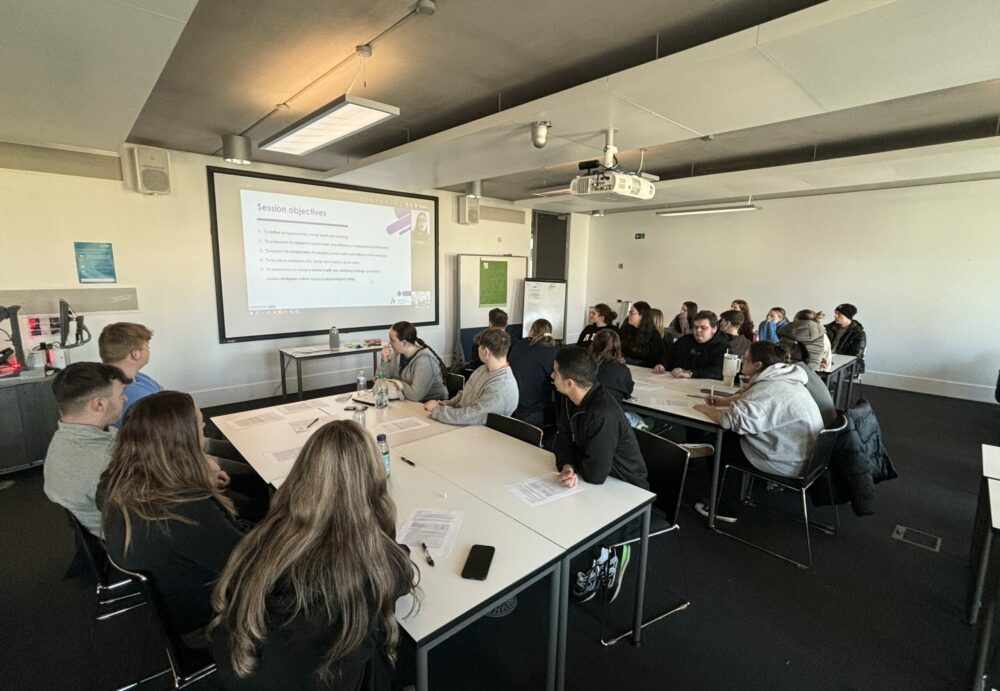
    One of the highlights of this journey was Vicky’s session using a Design Sprint simulation, where students followed the steps identified by Google, in order to design a solution to a real-world problem. In this case, developing a workplace wellbeing solution.

    Students had the opportunity to experience:

    • teaming
    • divergent and convergent thinking
    • root cause analysis
    • rapid prototyping
    • pitching

    Industry expertise was introduced to the session, with Marcia Fernandes from the Association for Accredited Learning providing the latest insights on the topic for our learners. You can read more about the session from Marcia here: https://www.associationforaccreditedlearning.co.uk/260124-2

  • For the majority of my career to date I have been a secondary school teacher. Since completing my PGCE in 2007 I have held the positions of Head of House, Head of Department and Head of Year. In September this year I was lucky enough to start a new chapter and try my hand at teaching in Higher Education as a University Lecturer.

    In this Blog I aim to explore how my existing knowledge and skills have travelled into HE and hopefully also reflect on how my experiences in my new role could shape the role of a school teacher for the better.